Dubai already has binding AI rules. Most firms working there have never read them.
The Gulf is usually described as having no AI law. For the Dubai International Financial Centre that is simply wrong, and has been for years: Regulation 10 of the DIFC Data Protection Regulations governs personal data processed through autonomous and semi-autonomous systems, and it binds.
What makes it bite for ordinary firms is who it names. The duty falls on the deployer — the business operating the system or getting the benefit of it — whether or not that business built the tool, hosts it, or controls what it does. Buying software off the shelf does not move the obligation to the vendor.
Across the wider UAE there is no single AI statute. Personal data is governed federally, and Abu Dhabi Global Market and the DIFC each run their own regime, so where you are registered decides which rules you are under.
Qatar and Saudi Arabia both bind AI through their data laws rather than through an AI law, and both are routinely described as stricter than they are. Qatar was the first in the Gulf to pass a personal data statute at all. Its central bank does impose hard AI rules, including approval before a high-risk system goes live — on the banks and insurers it licenses, and on nobody else. Saudi Arabia has no binding AI statute at all: what governs an AI deployment there is the data law, the transfer rules and your sector regulator's controls.
What actually governs AI in United Arab Emirates, Dubai International Financial Centre, Qatar and Saudi Arabia.
No summaries of summaries. Each of these was read at the publisher's own site, and the obligation is stated as the thing you have to do rather than the clause it comes from.
United Arab Emirates
Federal Decree-Law No. 45 of 2021 on the Protection of Personal Data. There is no federal AI statute.
Handle personal data lawfully across the whole business, and know which of the country's regimes you sit under — the federal law, the DIFC or ADGM — because they are not the same and registration decides it. The federal law reaches a controller or processor outside the UAE that handles the personal data of people inside it, so being registered elsewhere does not put you outside it. A company in a free zone that has its own personal data law is outside it, and under that instead. The federal law does not require a business to appoint a representative or agent in the UAE.
Dubai International Financial Centre
DIFC Data Protection Regulation 10, on personal data processed through autonomous and semi-autonomous systems.
Tell people, on first use, that they are dealing with a system that acts on its own — what it was built to do, where it is allowed to decide things for itself, what it produces and what you do with the output. High-risk uses need an Autonomous Systems Officer and certification under the Commissioner's framework. Neither the DIFC Data Protection Law nor its Regulations require a representative inside the DIFC.
Qatar
The Personal Data Privacy Protection Law, Law No. 13 of 2016 — the first of its kind in the Gulf. There is no AI statute. The Law covers personal data processed electronically, and it does not say whether a business outside Qatar is covered.
Process personal data lawfully and fairly, tell people what you are doing with it, keep it secure, and answer their requests. The Law does not require a business to appoint a representative or agent in Qatar. Data of a special nature — about health, physical or psychological condition, children, ethnic origin, religious belief, marriage or criminal offences — may only be processed with permission from the department the Law names. If you are licensed by the Qatar Central Bank, its Artificial Intelligence Guideline binds you on top of this, and a high-risk system needs the regulator's approval — the contract for it included — before it goes live.
Saudi Arabia
The Personal Data Protection Law. There is no binding AI statute.
Have a lawful basis for the personal data your AI uses, meet the transfer rules when that data leaves the Kingdom, and hold the security controls your sector's regulator sets. What binds an AI system here comes from the data law and from sector rules, not from an AI law. It reaches you even if you have no presence in Saudi Arabia: the law covers anyone outside the Kingdom processing the personal data of people inside it, and the authority is directed to enforce it beyond the border. Neither the Law nor its Implementing Regulation requires a business outside the Kingdom to appoint a representative there.
The Saudi Data and AI Authority publishes AI Ethics Principles and guidance on generative AI. Neither is law and neither carries a penalty — but alignment with them is increasingly asked for in public-sector procurement.
28 dates that decide whether you are compliant.
14 of them have already passed.
United Arab Emirates is one line of 9. Yours is marked. The DIFC was binding while most of Europe was still consulting. If you also have customers or staff elsewhere, you are on more than one of these.
Europe
- in force Obligations for general-purpose AI models.
- in force Article 50 transparency duties and enforcement powers for national regulators.
- coming New prohibitions, and Article 50(2) marking of synthetic content.
- coming Every Member State must have an AI regulatory sandbox running.
- coming High-risk obligations for Annex III systems — including AI used in recruitment, credit scoring, education and essential services.
- coming High-risk obligations for Annex I systems — AI embedded in products already covered by EU product safety law.
United Kingdom
- in force Most Part 5 data protection provisions of the Data (Use and Access) Act 2025, including the wider lawful bases for solely automated decisions and the safeguards that come with them.
- in force The duty on controllers to operate a complaints procedure and respond to data protection complaints within set time limits.
United States
- in force New York City Local Law 144 — an employer or agency using an automated employment decision tool for a New York City job needs a bias audit within the past year, published results, and notice to candidates.
- in force Washington My Health My Data Act (RCW 19.373) — consent before collecting or sharing consumer health data and a published health data privacy policy, for any business targeting Washington consumers; small businesses from 30 June 2024. A breach is an unfair practice under the Consumer Protection Act.
- in force Utah Artificial Intelligence Policy Act (SB 149, 2024) — a business using generative AI with a consumer must say so when the consumer clearly asks; licensed professions must disclose it up front in high-risk interactions. Narrowed by SB 226 from 7 May 2025, with a safe harbour for disclosing at the start.
- in force Texas HB 149, the Responsible Artificial Intelligence Governance Act — prohibited uses, government AI disclosure, and Attorney General enforcement.
- in force California SB 942, the AI Transparency Act — free AI detection tool and latent provenance disclosure for large generative AI providers. Delayed from 1 January 2026 by AB 853.
- coming Colorado SB 26-189 — developer and deployer duties for automated decision-making technology used in consequential decisions. It repealed and reenacted SB 24-205, which never took effect. California SB 1050 (Chapter 246, Statutes of 2026) — an advert shown in California that prominently features an AI-generated performer who looks or sounds human must say so clearly, in words like "this performance features a synthetic performer". Any size of business; enforced as false advertising. California CCPA regulations on automated decisionmaking technology (Cal. Code Regs. tit. 11, s. 7200) — a business using ADMT for a significant decision about a consumer must give pre-use notice, opt-out and access rights. In force 1 January 2026; businesses already using ADMT must comply by this date. Only businesses within the CCPA. Connecticut Public Act 26-15, sections 4 to 6 — duties on operators of AI companions, including detecting and responding to signs of self-harm. Washington HB 2225 (Chapter 168, Laws of 2026) — AI companion chatbots must disclose that they are not human, with safeguards for minors and a private right of action. A customer-service bot that does not sustain a relationship is excluded. Oregon SB 1546 (Chapter 85, Oregon Laws 2026) — operators of AI companions must tell users they are not talking to a person, keep a protocol for users who express thoughts of suicide or self-harm, and add safeguards for minors; a user who is harmed can sue. Software used solely for customer service, business operations or productivity is excluded.
- coming Idaho Conversational AI Safety Act (S 1297, Session Law Chapter 249 of 2026; Idaho Code Title 48, Chapter 21) — a conversational AI service open to the public must say it is AI where a person could be misled, answer prompts about suicide with a crisis referral, and protect account holders who are minors. Enforced by the Attorney General. A chatbot used only for customer service or a business's own operations is excluded.
- coming Connecticut Public Act 26-15 (Substitute SB 5, 2026), sections 7 to 12 — any business doing business in Connecticut that uses an automated employment-related decision technology for a hiring, promotion or discipline decision must disclose it and give written notice before the decision. No size threshold. A breach is an unfair trade practice.
- coming California CCPA regulations, s. 7157 — risk assessments conducted in 2026 and 2027 must be submitted to the California Privacy Protection Agency by this date.
Canada
- in force Ontario ESA / O. Reg. 476/24 — a publicly advertised job posting must disclose the use of AI to screen, assess or select applicants. Employers of 25 or more, including where a third party screens on their behalf.
Australia
- coming Privacy Act 1988 (Cth), APP 1.7 — a privacy policy must say what kinds of personal information a computer program uses to make decisions that could reasonably be expected to significantly affect a person, and what kinds of decisions those are — the automated decision-making (ADM) transparency obligations, regulated by the OAIC.
United Arab Emirates this page
- in force DIFC Data Protection Regulation 10 — a business deploying an autonomous or semi-autonomous system that processes personal data must tell users, on first use, what the system decides for itself, what it was built to do and what it does with the output.
Saudi Arabia
- in force The Saudi Data and AI Authority's grace period under the Personal Data Protection Law ends, and with it the undertaking not to apply penalties. The authority has said it may extend the grace period for a business that gives it good reason.
South Korea
- in force Framework Act on the Development of Artificial Intelligence and Establishment of a Foundation for Trust in force. A business in the AI industry must tell users in advance where a product runs on generative or high-impact AI, and label what generative AI produces. It applies to conduct outside Korea that affects the Korean market or its users.
China
- in force Personal Information Protection Law in force. A business outside China that handles the personal information of people in China — to offer them products or services, or to analyse their behaviour — must have a lawful basis for it and must appoint a representative or a dedicated body inside the country. Nothing in the duty turns on how much data is held.
Does this apply to you?
Most firms read a page like this and conclude it is about somebody bigger. These are the things that decide it, and the first one catches almost everybody.
- You are registered in the DIFC and run anything that answers customers, screens applicants or scores risk.
- You bought the system in. Regulation 10 names the deployer, not just the developer.
- Your customer-facing notices describe your data handling but say nothing about what the system decides on its own.
What we would do about it.
We build AI compliance frameworks — the policy, the register of where AI touches your business, the record that shows a regulator you thought about it before something went wrong. Fixed price, plain English, written for a business owner rather than a lawyer.
Every price, every line and every figure below is read from the same place the checkout reads it, so what the page says and what you are charged cannot drift apart.
- Which countries in the region reach your business, and on what basis
- AI Acceptable Use Policy
- Employee AI guidelines
- Data processing documentation for AI tools
- Cross-border data transfer position
- Basic compliance roadmap
- ISO/IEC 42001 and NIST AI RMF alignment map
- Answers to the AI questions clients send their suppliers
In your inbox by the end of the business day · annual — covers you for 12 months, renews yearly, legal updates included
Buy Foundation — £797/year →- Everything in Middle East AI Compliance Foundation
- Local representative requirements assessment
- Consumer-facing AI transparency disclosures
- AI Risk Register (populated for your current tools)
- Incident Response Procedure
- HR AI procedures and disclosure templates
- Monitoring and logging procedures
- Banned AI practices declaration
- Your AI compliance dashboard: a to-do list, your AI tools, staff sign-off, an incident log, every document and a shareable statement See the dashboard →
In your inbox by the end of the business day · annual — covers you for 12 months, renews yearly, legal updates included
Buy Complete — £1,497/year →Not sure which countries reach you? That is the first document in both tiers, and it names the ones that do not as well as the ones that do. If you would rather talk it through first, the call below is free and there is no pitch deck.
Read it before you buy it.
This is not a mock-up or a contents page. It is a genuine Middle East AI Compliance pack — all 13 documents — produced by the same system that will produce yours, for a fictional firm of consulting engineers we invented to test it. They have no office anywhere in the Gulf, and three of the region's regimes reach them anyway. That is the question this pack answers, and it names the regimes that do not reach them as well as the ones that do.
26 September 2026 — added: Answers to the AI questions clients send their suppliers
The gap. Public bodies and large companies now send their suppliers questions about the AI they use. Our frameworks held most of the answers, but a client had to know where to look, usually with a renewal waiting.
What we added. The questions real buyers publish, each put in plain words, with the document in your framework that answers it and anything still yours to do.
24 September 2026 — added: ISO/IEC 42001 and NIST AI RMF alignment map
The gap. Bigger clients, insurers and tenders can ask a supplier whether its AI governance meets ISO/IEC 42001 or the NIST AI Risk Management Framework. Our frameworks held most of the evidence, but nothing in them showed it.
What we added. A map that names, clause by clause, which of your documents meets each standard and what is still yours to do. It shows alignment, not certification.
Every framework, in all seven markets, has these changes. The pages below were made before them, so they show 2 documents fewer than a framework bought today.

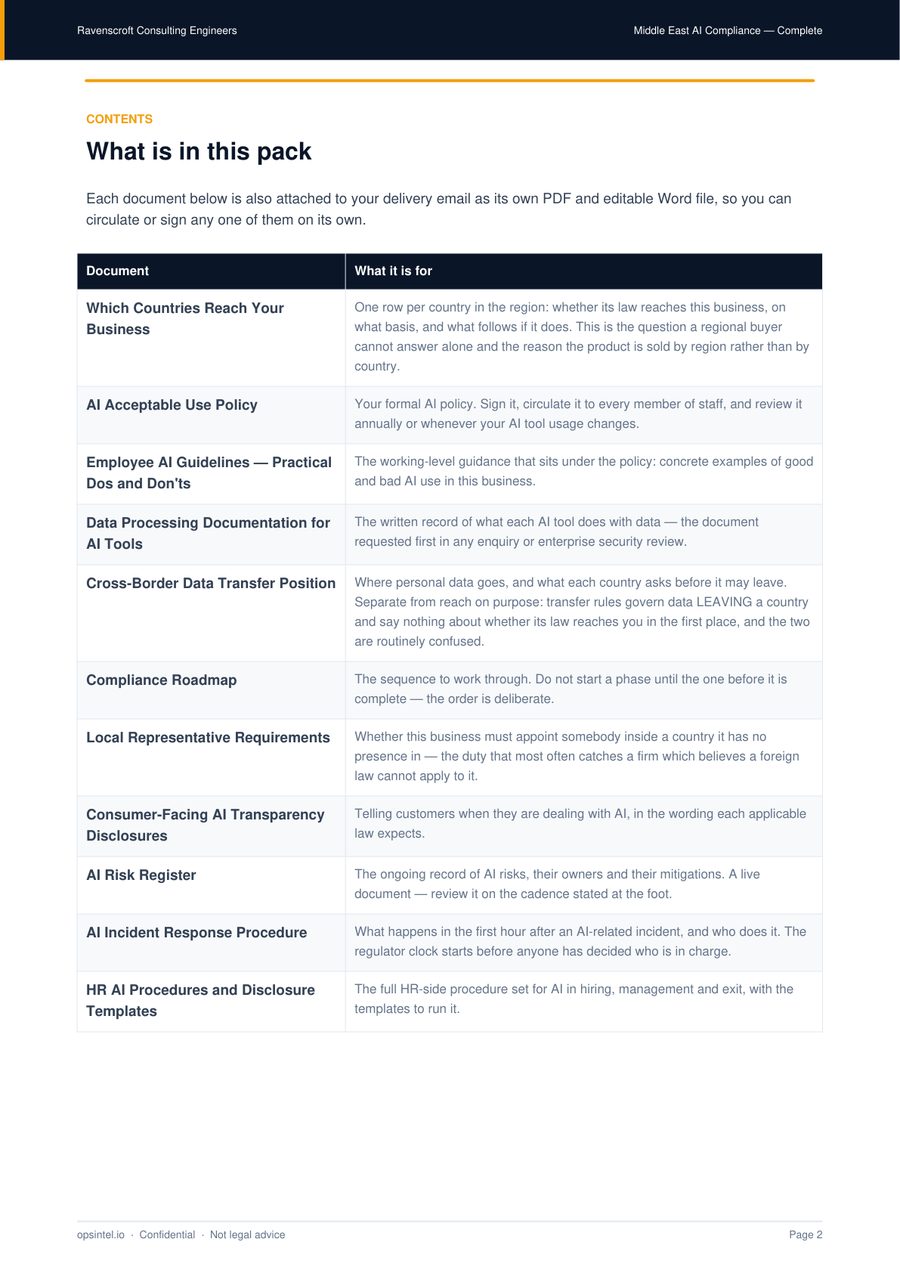
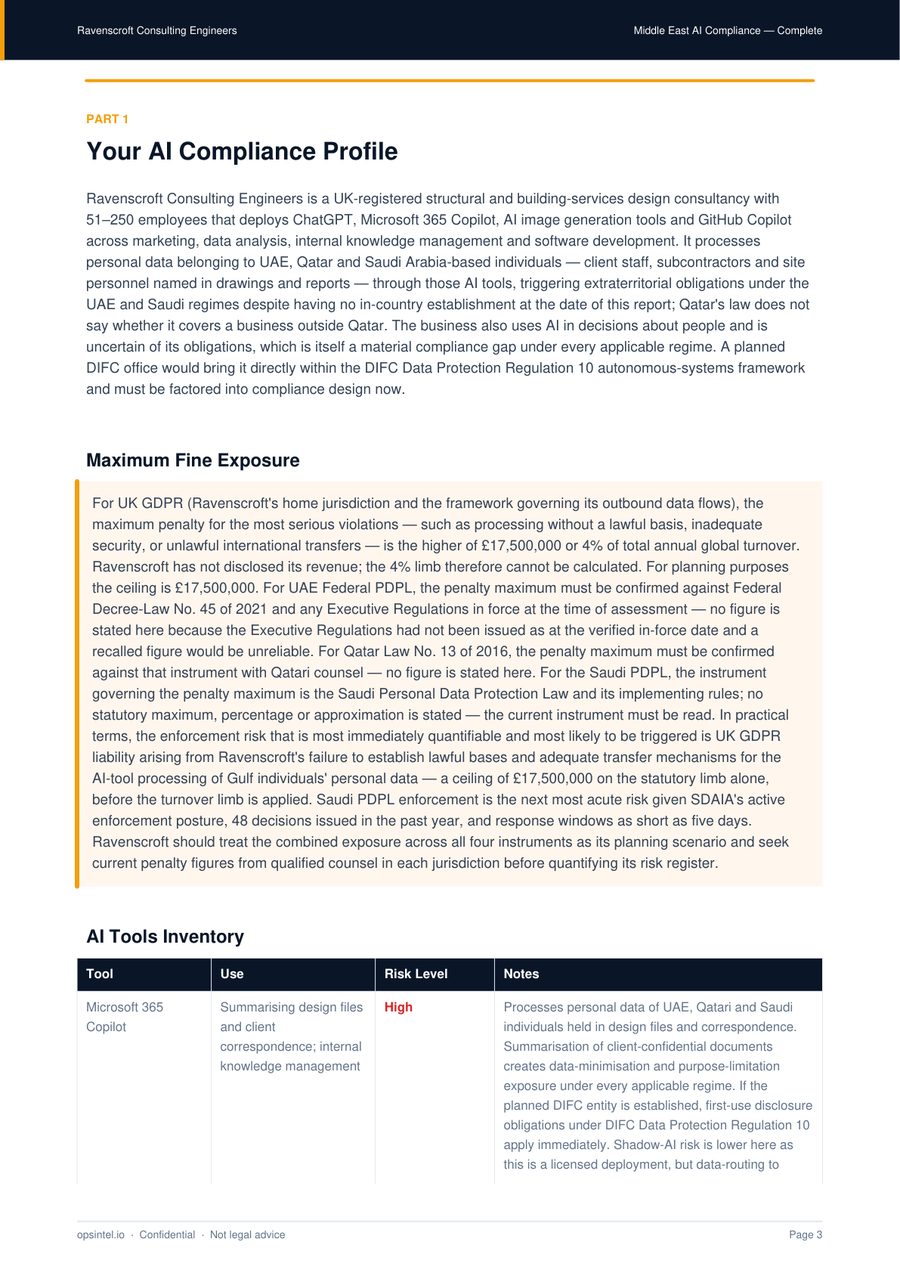
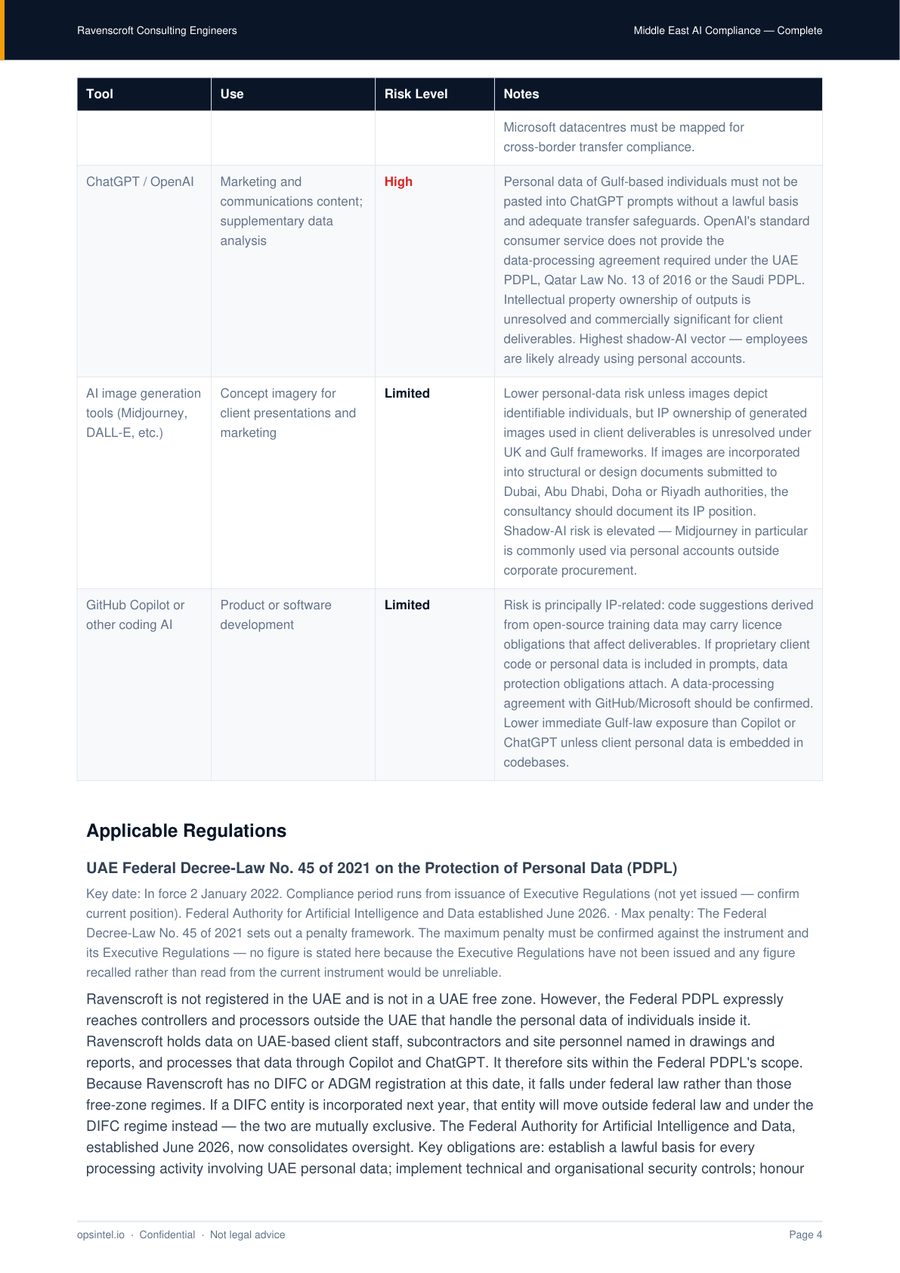
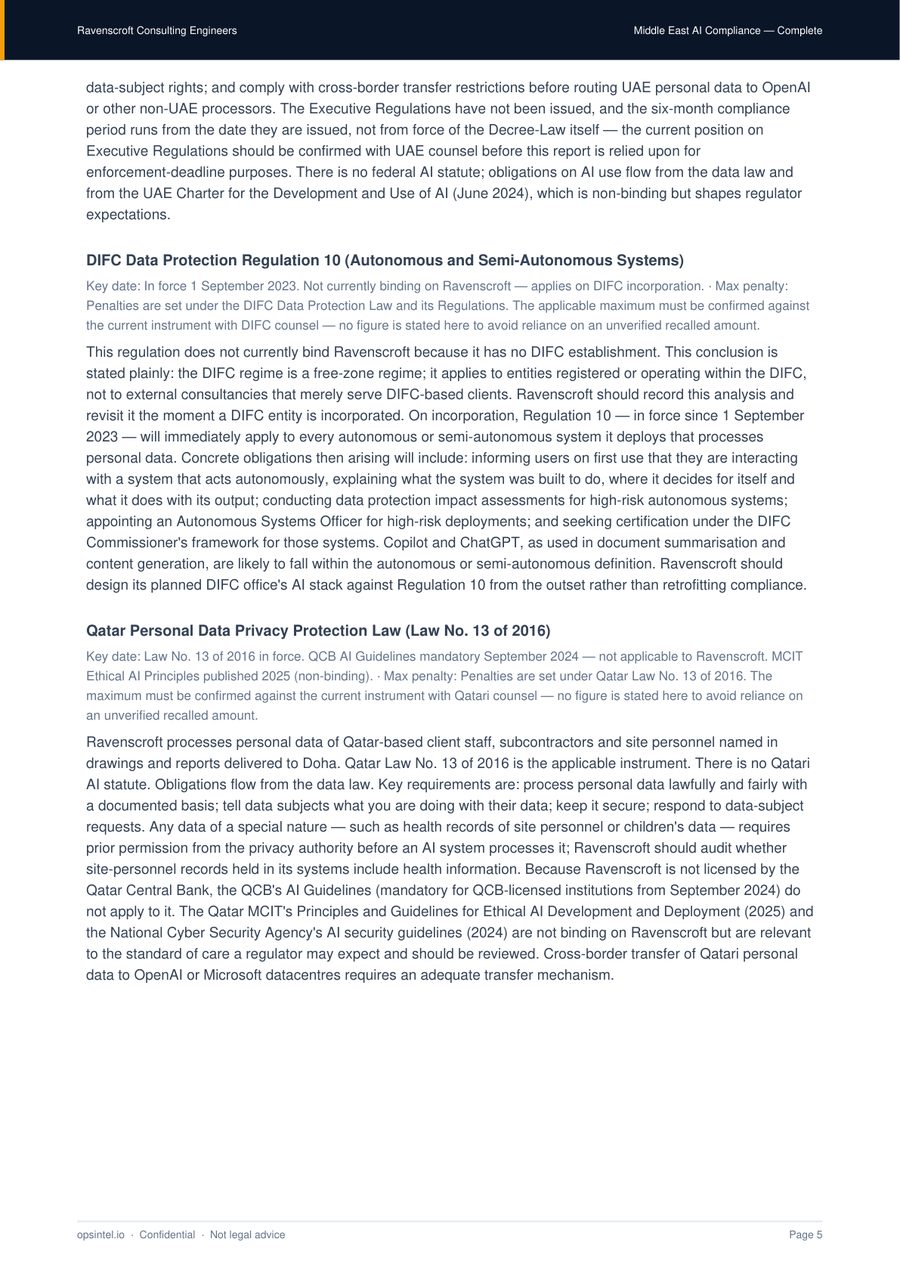
This framework also comes with a compliance dashboard you run all year: a dated to-do list, your AI tools and their risks, staff sign-off, an incident log, every document to download, the deadlines for your markets and a statement you can share. See a fictional example → · What the dashboard does →
The same work, done in-house.
8 documents to write, and 15 records a year to keep afterwards. Costed against what a member of staff on the median UK salary actually costs an hour:
£1,556+
Your own staff — 60 hours of their time
£797/year
Middle East AI Compliance — in your inbox by the end of the business day
Marked + because the reading is not in that figure yet — we are still counting this market's statutes, so the real in-house cost is higher than shown, never lower.
Find out where you stand in Middle East.
A free call, no pitch deck. We will tell you which of the obligations above reach your business and which do not — including if the answer is none of them.