Your clients will ask about your AI. We write the answer.
Supplier reviews are starting to ask what AI a business uses, what data goes into it and who is accountable for it. Some insurers have started writing AI out of standard business cover. We write your AI compliance framework in plain English, specific to how your business actually uses AI, so the answer is ready before anyone asks. Fixed price. Plain English. No lock-in.
About two minutes. No email needed to see your result.
Tick what your business actually does.
apply to you
Nothing selected — tick one above and watch.
Where AI compliance has been, where it is, and where it’s going
Every dated obligation across the UK, EU and US — what has landed, and what is coming.

Global. Straightforward. No nonsense.
"I started Ops Intel because I watched too many good businesses use AI tools without any compliance framework — and assume that because nothing had gone wrong yet, nothing would."
"We write the framework, we keep it current as the law moves, and we make sure you can hand it over the day somebody asks for it. That is the whole job."
Scott Neve — Founder, Ops Intel
Three people are going to ask about your AI.
Here's who, and what they'll want to see.
“What AI do you use, what data goes into it, and who signs it off?”
Your framework is the written answer to the questions buyers send. The free AI risk checker gives you a dated one-page summary you can forward the same day.
“Can you show how AI is governed in your business?”
Some insurers have started to exclude AI losses from standard cover. A written framework is the evidence that you have it under control.
“Are you meeting the law in every market you sell into?”
UK GDPR already applies to any AI that touches personal data. The EU AI Act reaches any firm whose AI is used in the EU. This is the most each can fine:
Maximum fine for non-compliance with the EU AI Act for prohibited AI practices. GPAI (general-purpose AI) obligations are already in force. High-risk AI deadlines land December 2027.
Maximum fine under UK GDPR for organisations that fail to protect personal data — including data processed by AI tools. The ICO is actively investigating AI systems right now.
Per violation under Texas and Illinois AI laws. US state AI legislation is accelerating — with consumer protection fines that compound per affected individual.
Fixed price. Plain English. Specific to your business. Not a template.
A policy is a document.
A framework is a system.
Most firms have a policy in a folder somewhere. What a regulator asks for is evidence that it is enforced, reviewed and current — and that is six documents, not one.
The AI Compliance Framework
Six documents. One system. Fixed price.
- Acceptable Use Policy
- Data Classification Matrix
- GDPR Compliance Position
- Employee Training & Acknowledgement
- AI Risk Register
- Incident Response Procedure
Every framework is mapped to ISO/IEC 42001 and the NIST AI Risk Management Framework, clause by clause.
Not ready for all six? Start with the policy.
Three to eight pages setting out how AI may be used in your business, in plain English. It does not stop your team using AI. It stops them using it dangerously.
Get your AI policyTrading in more than one country? More than one law applies.
Which ones depends on where your customers are, where your staff are and where your AI has effect — not where the business is registered.
- UK
- EU
- US
- Canada
- Middle East
- Far East
- Australasia
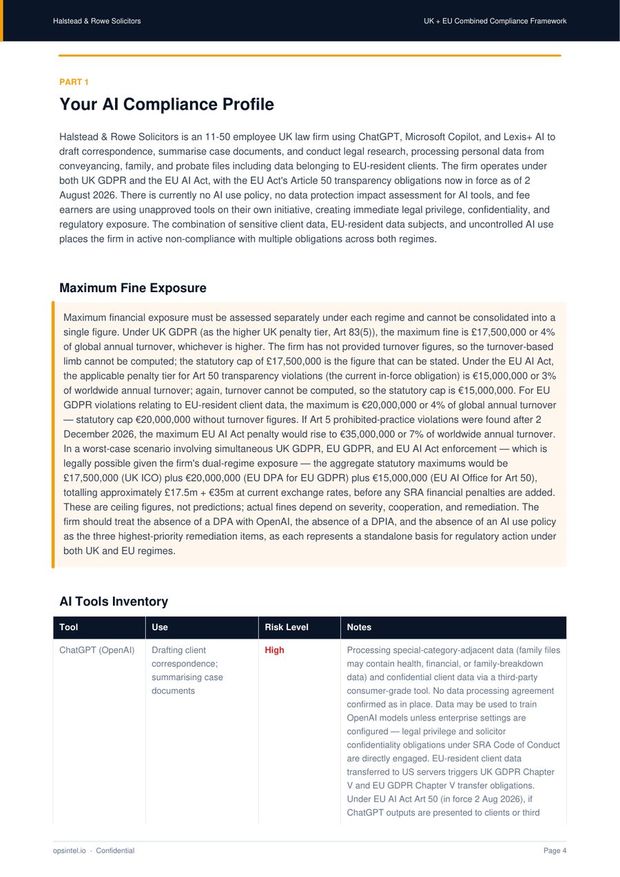
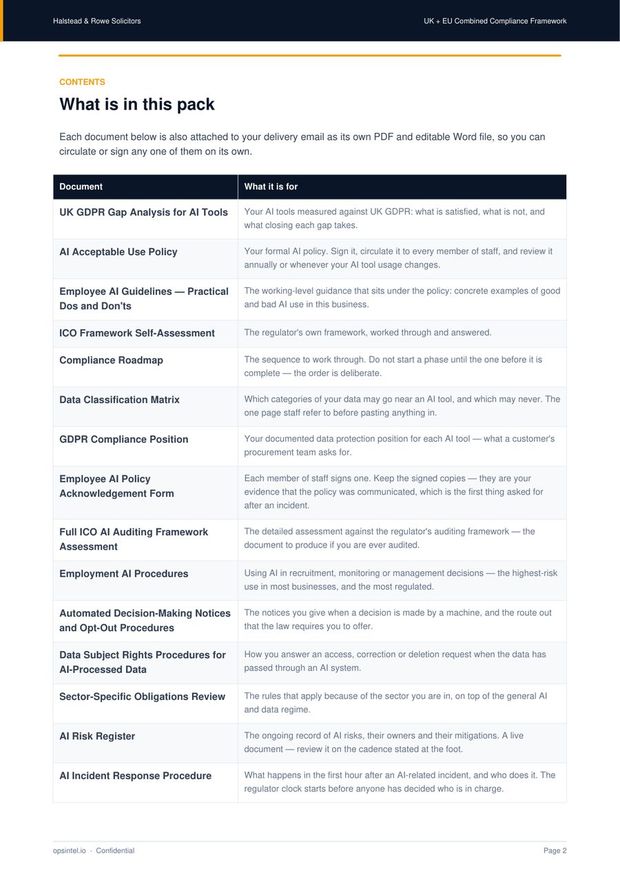
This is the thing itself.
Not a picture of one.
A genuine UK + EU Combined Compliance Framework, produced by the same system that will produce yours, for a fictional firm of solicitors we invented to test it. Written around what that firm actually does with AI — which is why it is long, and why a template could never have been.
Read it page by page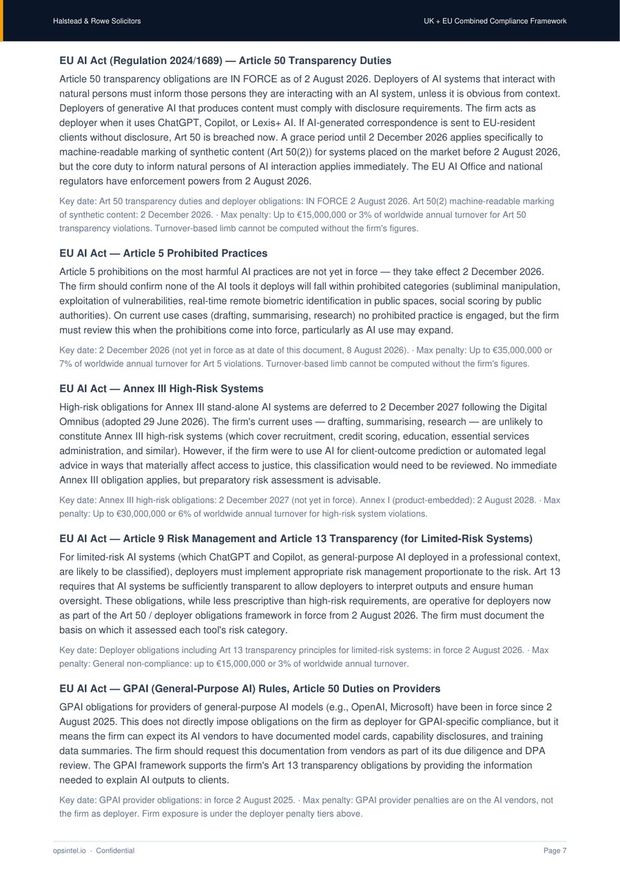

Included with every Complete framework
When they ask, you send the record.
Your framework comes with a compliance dashboard your business runs all year, and every change on it is dated.
- Your AI tools and the risk each one carries, with the next review date set by that risk.
- Your staff sign the policy from their own link, and the date lands on the record.
- Incidents: what went wrong, what you did, and when it was closed.
- A report and a statement to hand to a client, an insurer or a regulator.
The same work, done in-house.
718 pages of primary law to read, 14 documents to write, and 15 records a year to keep afterwards. Costed against what a member of staff on the median UK salary actually costs an hour:
£4,586
Your own staff — 177 hours of their time
£797/year
UK AI Compliance — in your inbox by the end of the business day
What it's like to work with us.
Before Scott got involved, our website was embarrassing — it wasn't doing us any favours. He rebuilt it completely, built us a custom property valuation tool that we're now rolling out to clients, and sorted out our AI compliance so we're covered on the data side. He also set up automations that have taken a few of the repetitive jobs off our plate.
What I found different about working with Scott is that he actually explains what he's doing and why it matters — he doesn't just disappear and come back with something. The valuation tool in particular is something clients have already noticed, and that's the kind of thing that helps us stand out in a competitive market.
If you're an estate agent thinking about your digital setup or your AI compliance, I'd go to Scott first.
- AI compliance framework
- Website rebuild
- Custom valuation tool
- Workflow automation
As quoted in TechTarget and GENZ TECH
“Businesses don't pick one regime to comply with. They end up building to the strictest one that reaches them and applying it everywhere, because running different data-handling rules per jurisdiction is operationally more expensive than the fine risk of the laxer one.”
“The damage is the gap between what the agent was asked to do and what it was allowed to do, and most businesses never wrote the first part down.”

For journalists
Writing about AI regulation? Find Scott Neve on Qwoted to request a comment.
Everything you need to know.
More questions? Read our full FAQ →
Nobody gets a warning first.
They get a complaint, and then an investigation.
Most businesses using AI have nothing to hand over when somebody asks — no policy, no record of which tools their staff use, nobody named as responsible. In 30 minutes we will tell you which laws apply to you, where you are exposed today, and exactly what you would have to produce. No obligation, no hard sell.
Claim Your Free Audit →