Australia has no AI Act — and one hard deadline that catches automated decisions.
Australia has no AI Act. The mandatory guardrails for high-risk AI that were proposed in 2024 were not taken forward, and the Australian Standards for AI the government has since announced set rules for large data centres and for training AI on Australian creative work — not for a business that uses AI tools. For that business, the law you already have — privacy, consumer, anti-discrimination — is the law that governs what your AI does.
That is easy to hear as "nothing to do", and it is the opposite. A regulator applying existing law to a new tool gives you no implementation window and no checklist. The one hard date in the calendar sits in the Privacy Act, and it asks a question most firms cannot currently answer: which of your decisions are made by a computer, and what does it use to make them?
New Zealand has taken the same route with no AI statute of its own, and its Privacy Commissioner has been explicit that the Privacy Act applies to everyone using AI tools there.
What actually governs AI in Australia and New Zealand.
No summaries of summaries. Each of these was read at the publisher's own site, and the obligation is stated as the thing you have to do rather than the clause it comes from.
Australia
The Privacy Act 1988 (Cth) and the Australian Privacy Principles. There is no AI-specific statute. The Act reaches a business outside Australia that carries on business in Australia. It does not reach a small business — one whose annual turnover has never been above three million Australian dollars in a financial year, counted across the whole business rather than only its Australian sales — unless, among other exceptions, that business provides a health service and holds health information, or trades in personal information. A business stops being a small business only once a financial year in which its turnover was above that line has ended. The Act sets the line in Australian dollars and says nothing about how turnover earned in another currency is converted, so a business trading in pounds should record the rate it used. An employer's handling of employee records about its own current and former staff is exempt where it relates directly to that employment.
If the Act reaches you, your privacy policy must account for decisions made by a computer program where those decisions could reasonably be expected to significantly affect somebody's rights or interests — what personal information goes in, and what kinds of decisions come out. The duty is on the business that arranged for the program to make or feed the decision, whether or not it built the program. Writing that down means first knowing where automated decisions happen in your business, which is the work. The Act does not require a business outside Australia to appoint a representative or agent there.
The National AI Centre publishes Guidance for AI Adoption, which develops the earlier Voluntary AI Safety Standard into six practices. It is voluntary and it is what a tender will ask you about.
New Zealand
The Privacy Act 2020 and its information privacy principles. There is no AI-specific statute. The Act reaches a business overseas for anything it does in the course of carrying on business in New Zealand, wherever the information is collected or held — and a business can be carrying on business there without an office there and without being paid. There is no exemption for a small business.
Before you use or disclose personal information — including what an AI tool produces about a person — take reasonable steps to make sure it is accurate, up to date, complete, relevant and not misleading. For an AI tool, that means knowing what it gets wrong before you rely on what it says. The Act does not require a business overseas to appoint a representative or agent in New Zealand.
The Privacy Commissioner's starting point is that the Privacy Act applies to everyone using AI tools in New Zealand, and its guidance recommends a privacy impact assessment before you start using one, kept up to date.
17 dates that decide whether you are compliant.
11 of them have already passed.
Australia is one line of 9. Yours is marked. Almost every business we speak to sits on more than one of these lines, because they follow your customers and your staff rather than your head office.
Europe
- in force Obligations for general-purpose AI models.
- in force Article 50 transparency duties and enforcement powers for national regulators.
- coming New prohibitions, and Article 50(2) marking of synthetic content.
- coming Every Member State must have an AI regulatory sandbox running.
- coming High-risk obligations for Annex III systems — including AI used in recruitment, credit scoring, education and essential services.
- coming High-risk obligations for Annex I systems — AI embedded in products already covered by EU product safety law.
United Kingdom
- in force Most Part 5 data protection provisions of the Data (Use and Access) Act 2025, including the wider lawful bases for solely automated decisions and the safeguards that come with them.
- in force The duty on controllers to operate a complaints procedure and respond to data protection complaints within set time limits.
United States
- in force Texas HB 149, the Responsible Artificial Intelligence Governance Act — prohibited uses, government AI disclosure, and Attorney General enforcement.
- in force California SB 942, the AI Transparency Act — free AI detection tool and latent provenance disclosure for large generative AI providers. Delayed from 1 January 2026 by AB 853.
- coming Colorado SB 26-189 — developer and deployer duties for automated decision-making technology used in consequential decisions. It repealed and reenacted SB 24-205, which never took effect.
Canada
- in force Ontario ESA / O. Reg. 476/24 — a publicly advertised job posting must disclose the use of AI to screen, assess or select applicants. Employers of 25 or more, including where a third party screens on their behalf.
Australia this page
- coming Privacy Act 1988 (Cth), APP 1.7 — a privacy policy must say what kinds of personal information a computer program uses to make decisions that could reasonably be expected to significantly affect a person, and what kinds of decisions those are.
United Arab Emirates
- in force DIFC Data Protection Regulation 10 — a business deploying an autonomous or semi-autonomous system that processes personal data must tell users, on first use, what the system decides for itself, what it was built to do and what it does with the output.
Saudi Arabia
- in force The Saudi Data and AI Authority's grace period under the Personal Data Protection Law ends, and with it the undertaking not to apply penalties. The authority has said it may extend the grace period for a business that gives it good reason.
South Korea
- in force Framework Act on the Development of Artificial Intelligence and Establishment of a Foundation for Trust in force. A business in the AI industry must tell users in advance where a product runs on generative or high-impact AI, and label what generative AI produces. It applies to conduct outside Korea that affects the Korean market or its users.
China
- in force Personal Information Protection Law in force. A business outside China that handles the personal information of people in China — to offer them products or services, or to analyse their behaviour — must have a lawful basis for it and must appoint a representative or a dedicated body inside the country. Nothing in the duty turns on how much data is held.
Does this apply to you?
Most firms read a page like this and conclude it is about somebody bigger. These are the things that decide it, and the first one catches almost everybody.
- You use a tool that scores, ranks, shortlists or prices — recruitment screening, credit decisions, claims triage.
- You bought that tool rather than built it. The duty is on the business that arranged for the program to decide, not on whoever wrote it.
- You sell to customers in Australia, your turnover has passed three million Australian dollars, and your privacy policy was written before any of this existed.
What we would do about it.
We build AI compliance frameworks — the policy, the register of where AI touches your business, the record that shows a regulator you thought about it before something went wrong. Fixed price, plain English, written for a business owner rather than a lawyer.
Every price, every line and every figure below is read from the same place the checkout reads it, so what the page says and what you are charged cannot drift apart.
- Which countries in the region reach your business, and on what basis
- AI Acceptable Use Policy
- Employee AI guidelines
- Data processing documentation for AI tools
- Cross-border data transfer position
- Basic compliance roadmap
In your inbox by the end of the business day · annual — covers you for 12 months, renews yearly, legal updates included
Buy Foundation — £797/year →- Everything in Australasia AI Compliance Foundation
- Local representative requirements assessment
- Consumer-facing AI transparency disclosures
- AI Risk Register (populated for your current tools)
- Incident Response Procedure
- HR AI procedures and disclosure templates
In your inbox by the end of the business day · annual — covers you for 12 months, renews yearly, legal updates included
Buy Complete — £1,497/year →Not sure which countries reach you? That is the first document in both tiers, and it names the ones that do not as well as the ones that do. If you would rather talk it through first, the call below is free and there is no pitch deck.
Read it before you buy it.
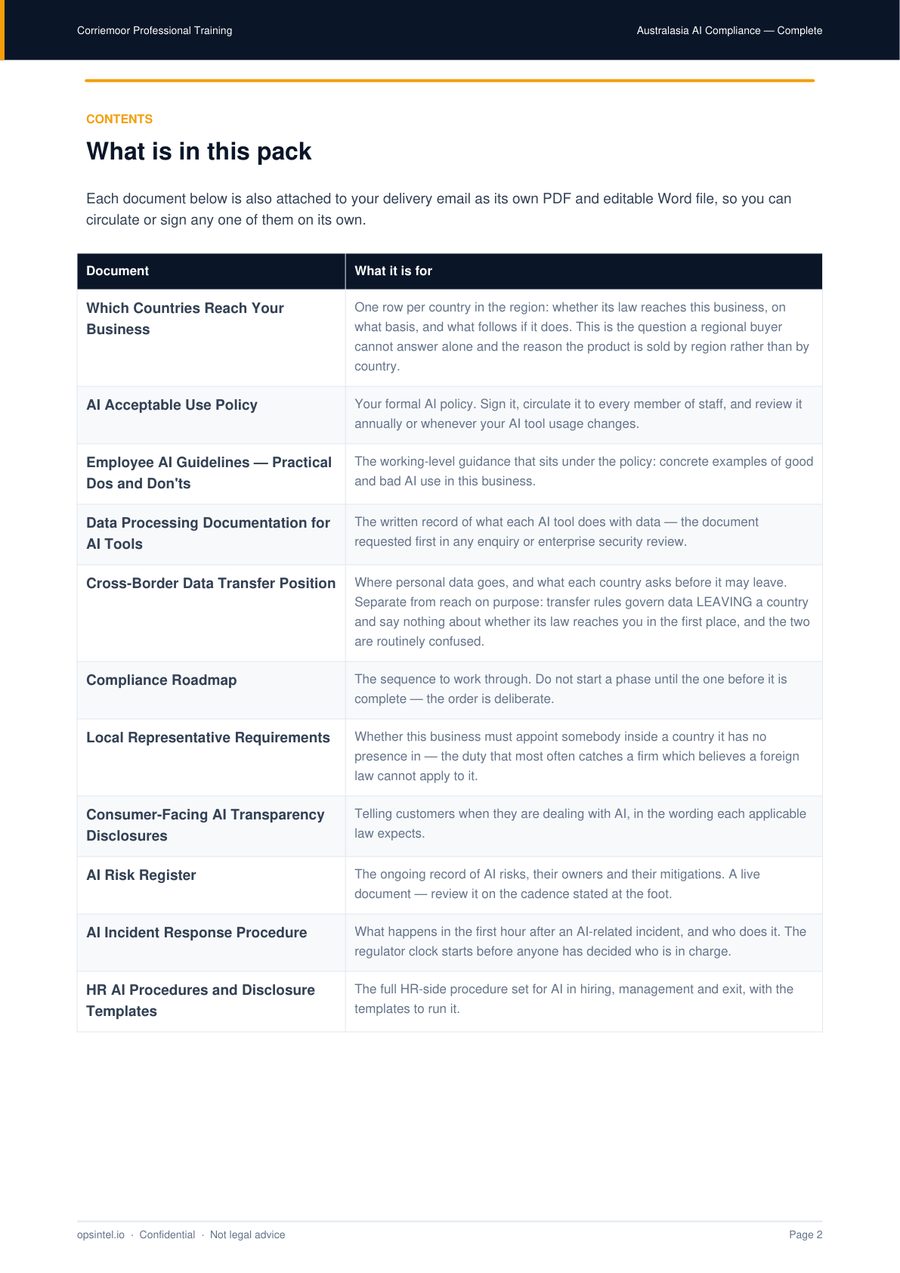
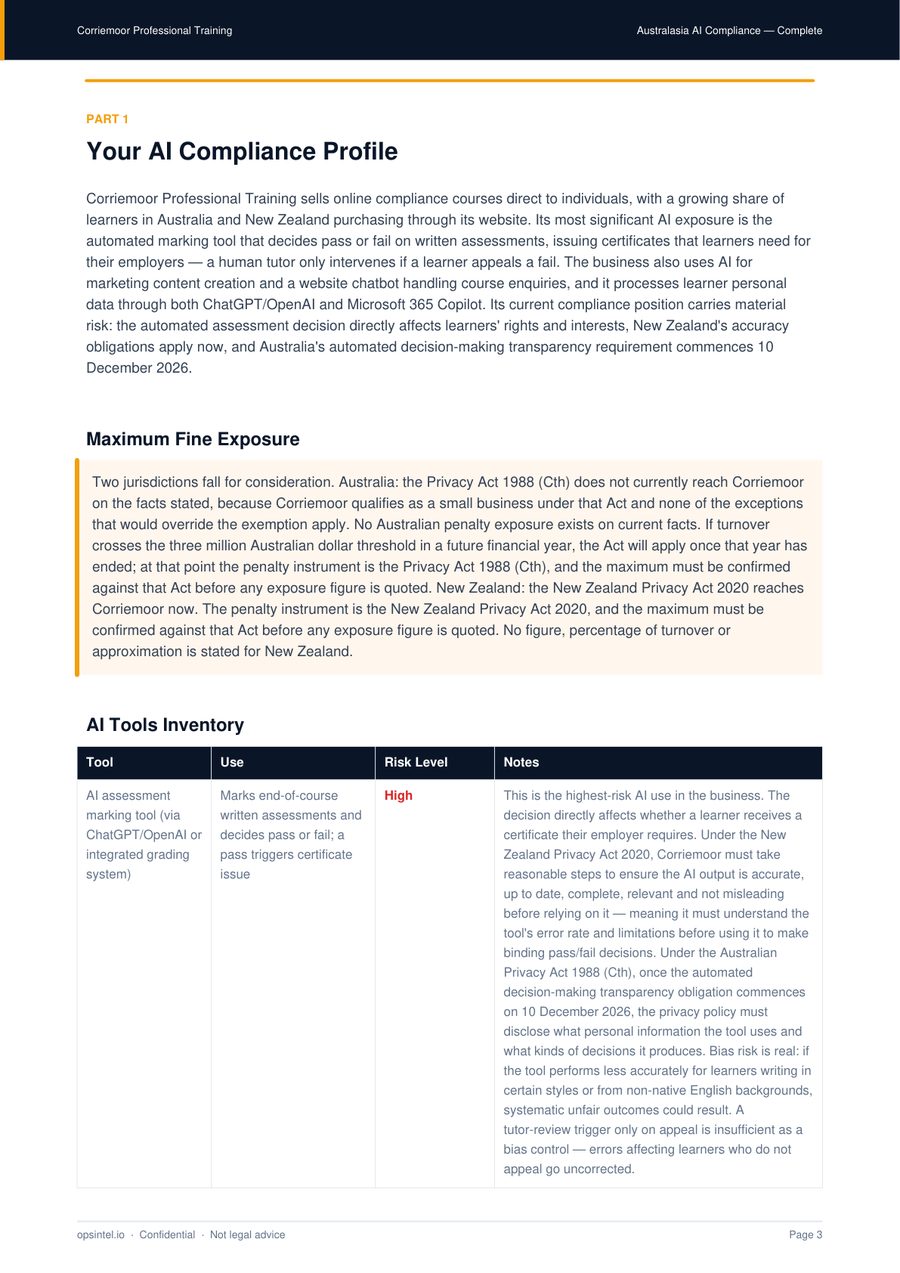
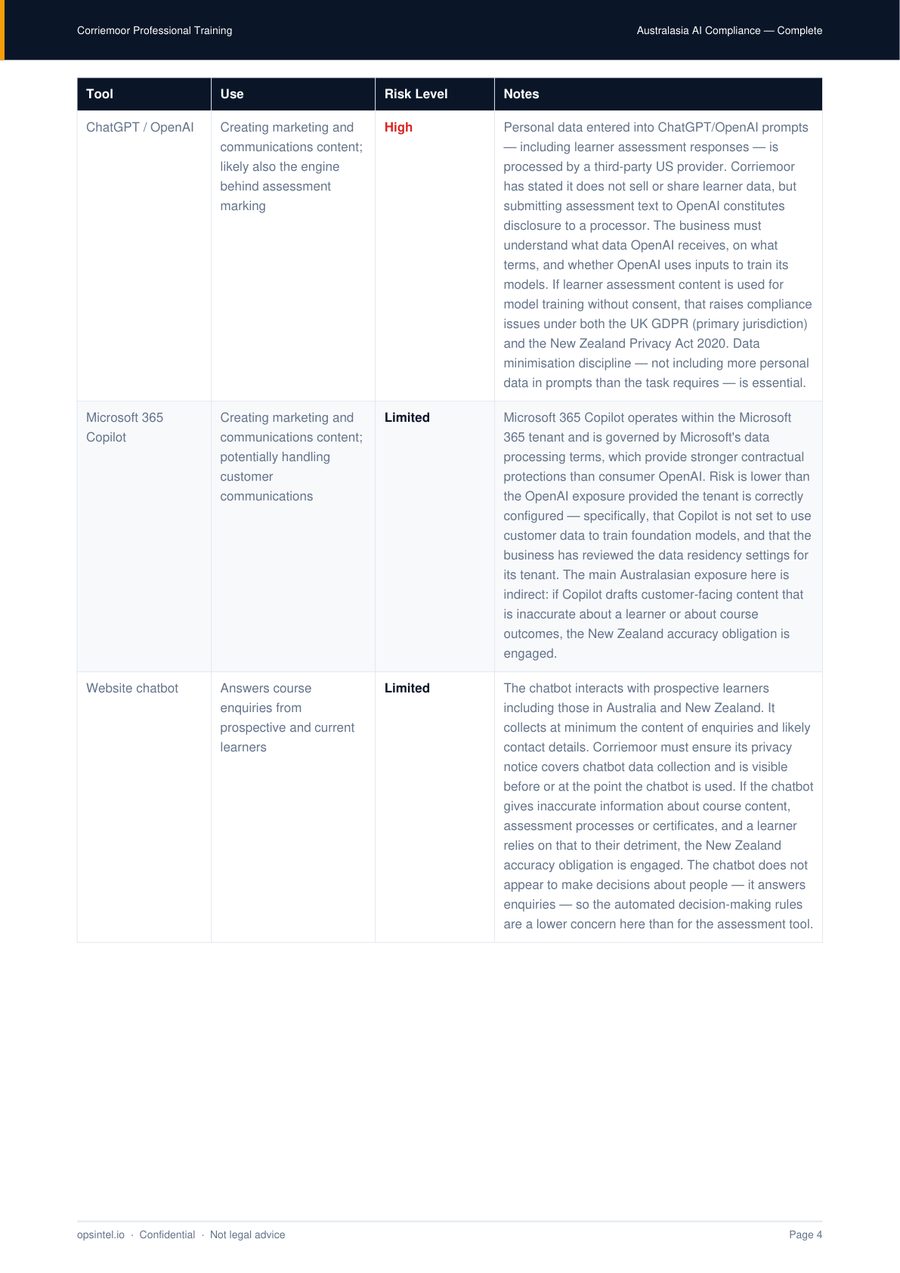
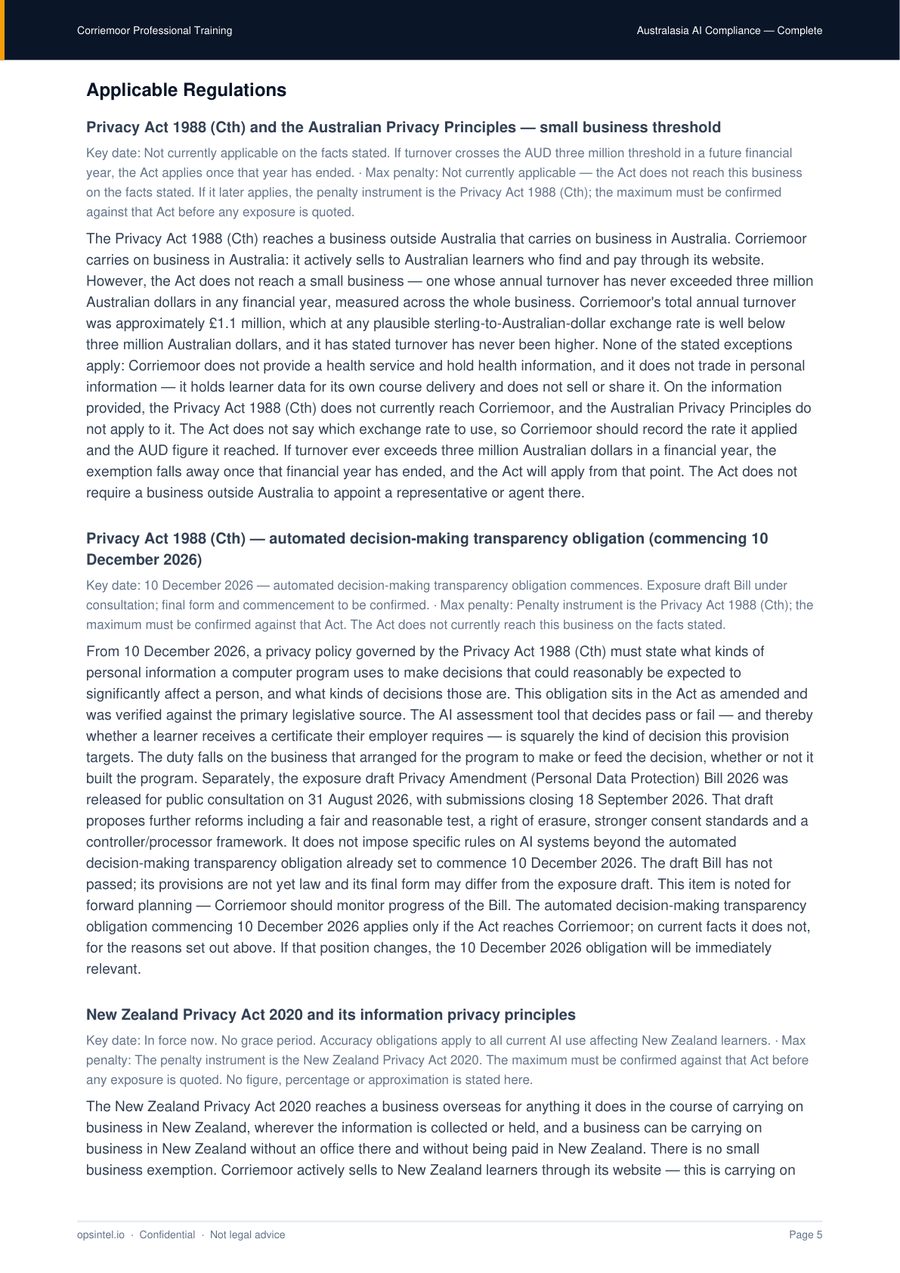
This is not a mock-up or a contents page. It is a genuine AI Policy — Essentials pack, produced by the same system that will produce yours, for a fictional accountancy practice we invented to test it. Every page below came out of the real thing.

The same work, done in-house.
6 documents to write, and 15 records a year to keep afterwards. Costed against what a member of staff on the median UK salary actually costs an hour:
£1,167+
Your own staff — 45 hours of their time
£797/year
Australasia AI Compliance — in your inbox by the end of the business day
Marked + because the reading is not in that figure yet — we are still counting this market's statutes, so the real in-house cost is higher than shown, never lower.
Find out where you stand in Australasia.
A free call, no pitch deck. We will tell you which of the obligations above reach your business and which do not — including if the answer is none of them.